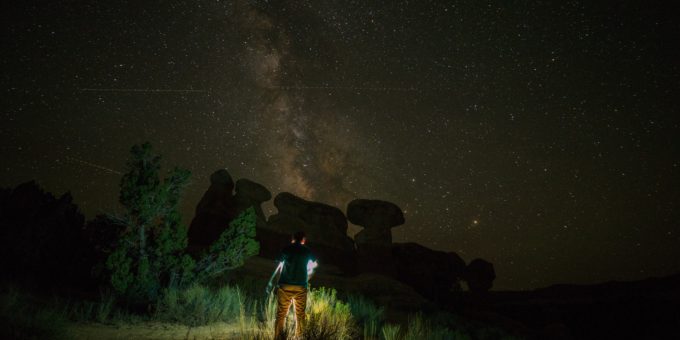
Humans have been obsessed with the sky for thousands of years. After all, it was one of the first things that told us that we were not alone in our universe. This obsession with the sky lives in all of us. Therefore, if you’ve recently found yourself looking up at the sky in awe, you may want to embark on your own stellar adventure. Whether you wish to follow in the footsteps of Copernicus and Galileo Galilei, or more modern scientists like Stephen Hawking or Neil deGrasse Tyson — astronomy is accessible to all.
And once we decide to become amateur astronomers, there’s no force that can stop us. Indeed, the passion for the stars seems to get stronger the more that we learn about them. So that’s where every backyard astronomer starts.
Getting Started
More than anything, astronomy is about studying and learning. Rather than trying to set up a brand new system of classification for ourselves — it’s best to read up on what astronomers already know and agree upon. We could spend days in the library and online researching various stars, nebulas, and galaxies, and you most definitely will.
Still, in the interest of being practical, you should narrow down your search to recent publications. Perhaps you might even subscribe to one of the many excellent astronomical monthly publications. At this point, you may also consider joining some online discussion groups or local astronomy clubs, or even starting one of your own. Also, many universities host lectures open to the public that you could attend. If your local university does not, we suggest visiting the local Planetarium or the science museum.
Ultimately, when we start enjoying something to the point of fixation, most people indulge the instinct to dive in deep. However, some people assume that diving into astronomy requires them to spend a lot of money. Well, we’re here to say that’s not the case! After all, many professional astronomers started without a penny to their name, simply gazing up at the night sky. And what’s good for them is certainly good for us!
Looking Up
If you can, try to find a spot where there isn’t a lot of light pollution. Unfortunately, big cities these days make it increasingly difficult to become an astronomy enthusiast. If you manage to find a place that’s secluded enough within the city, you should always have safety in mind. This is where your astronomy club friends will come in handy — there’s safety in numbers. Bring along a couple of books and try to find the celestial bodies you see in them. In fact, there are also many apps that can help you figure out what you’re looking at, by using your phone’s GPS.
If for some reason you can’t get to a dark area, you could always just look at what’s visible: the moon! There are so many mysteries we haven’t managed to answer about our natural satellite and so many that we have. Read up on the moon and the various astronomical events that will be visible to the naked eye in the near future. You won’t believe how much you’ll be able to perceive and learn just by looking up.
Getting Optical Equipment
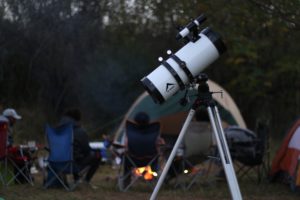
On the other hand, sometimes our eyes are not enough. Still, going for the priciest telescope on the market is inadvisable. Instead, we recommend starting off with a pair of binoculars or a smaller telescope. These tools are going to be much easier to carry around with you, which will, in turn, make you more likely to practice. After all, astronomy, like every other every other field of study, takes time to master.
What’s more, smaller optical instruments usually also have a wider field of view, which is especially helpful when you’re just starting out. Even professional astronomers often go stargazing with their smaller telescopes, because they’re so much easier to use. If you decide to purchase a telescope right off the gate, you should expect it to cost around $300, especially if you want a quality product.
Even at that price point, don’t expect the view to be as crystal clear as high-quality NASA photos. Still, you’ll definitely be able to see the planets — Jupiter and Saturn are a beautiful sight to see. Ultimately, that’s what it’s all about: appreciating all that the universe has to offer. So, grab a friend and some guidebooks and head outside. That’s essentially all you need to become a backyard astronomer!